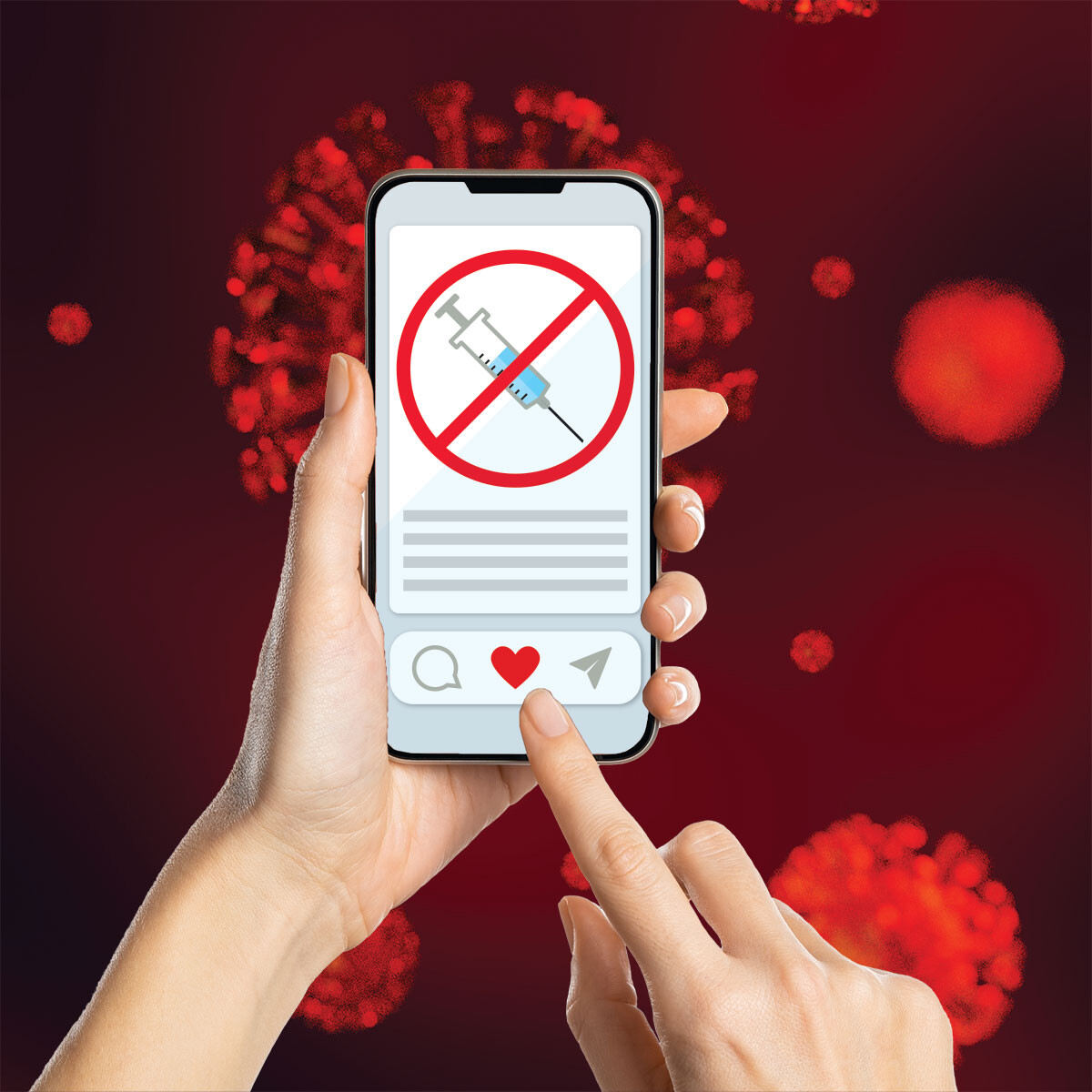
A photo of an anti vaccine social media post followed by a case study on C O V I D 19. The photo shows a smartphone held in an individual’s hand. With the other hand, the person selects the like or heart button under the anti vaccine post. Blurry models of virus particles are seen in the background of the photo. The case study is titled, C O V I D lungs are better than none. A silhouette of a person is shown at the center of the case study, along with two radiology images of lungs and a model of the S A R S C o V 2 virus particle. The case study reads, Scenario. Amber, age 25, was a truck driver, healthy aside from asthma. She was unvaccinated for C O V I D 19 because her social media sites opposed vaccines. One morning, Amber awoke with what felt like a mild cold. She was coughing and later in the day she had fever and felt short of breath. She visited an outpatient clinic. Testing. At the clinic, Amber tested positive for C O V I D 19 caused by S A R S C o V 2, the coronavirus that emerged in 2019 and is now endemic, or regularly occurring worldwide. Amber’s lung X ray revealed fluid buildup and airway damage. Alarmed, Amber now requested the C O V I D vaccine, but the clinician explained that vaccination only prevents disease several weeks before infection. Amber received oxygen and stayed overnight at the hospital. Fortunately, her symptoms improved and she returned home. Diagnosis. After a week at home, Amber’s initial symptoms were gone and she tested negative for virus. But she felt exhausted all the time. She had episodes of dizziness with a racing heart beat and she was diagnosed with a cardiac abnormality. She experienced brain fog, a condition in which she could not recall where she put things or the tasks needed for her job. Amber had to quit her job and go on governmental assistance. Two years after her initial C O V I D 19 infection, her lungs are scarred and have decreased capacity. Some of her symptoms improved, but her long term conditions remain. Amber was diagnosed with long C O V I D, also known as post C O V I D conditions, or P C C. Signs and Symptoms. P C C can affect multiple organs, including the lungs, heart, and brain, and in some cases the liver and kidneys. Various combinations of post C O V I D conditions may be experienced by 30 percent of those infected. While emerging therapies can alleviate post C O V I D symptoms, there is no known cure. However, vaccination before infection can decrease the incidence or rate of occurrence and severity of disease.
COVID Lungs Are Better Than None
More information
An illustrated silhouette of a female truck driver. The woman is wearing long pants, a collared shirt, a baseball cap, and sneakers. She is writing on a clipboard in her hand.
SCENARIO Amber, age 25, was a truck driver, healthy aside from asthma. She was unvaccinated for COVID-19 (COVID) because her social media sites opposed vaccines. One morning, Amber awoke with what felt like a mild cold. She was coughing, and later in the day she had fever and felt short of breath. She visited an outpatient clinic.
More information
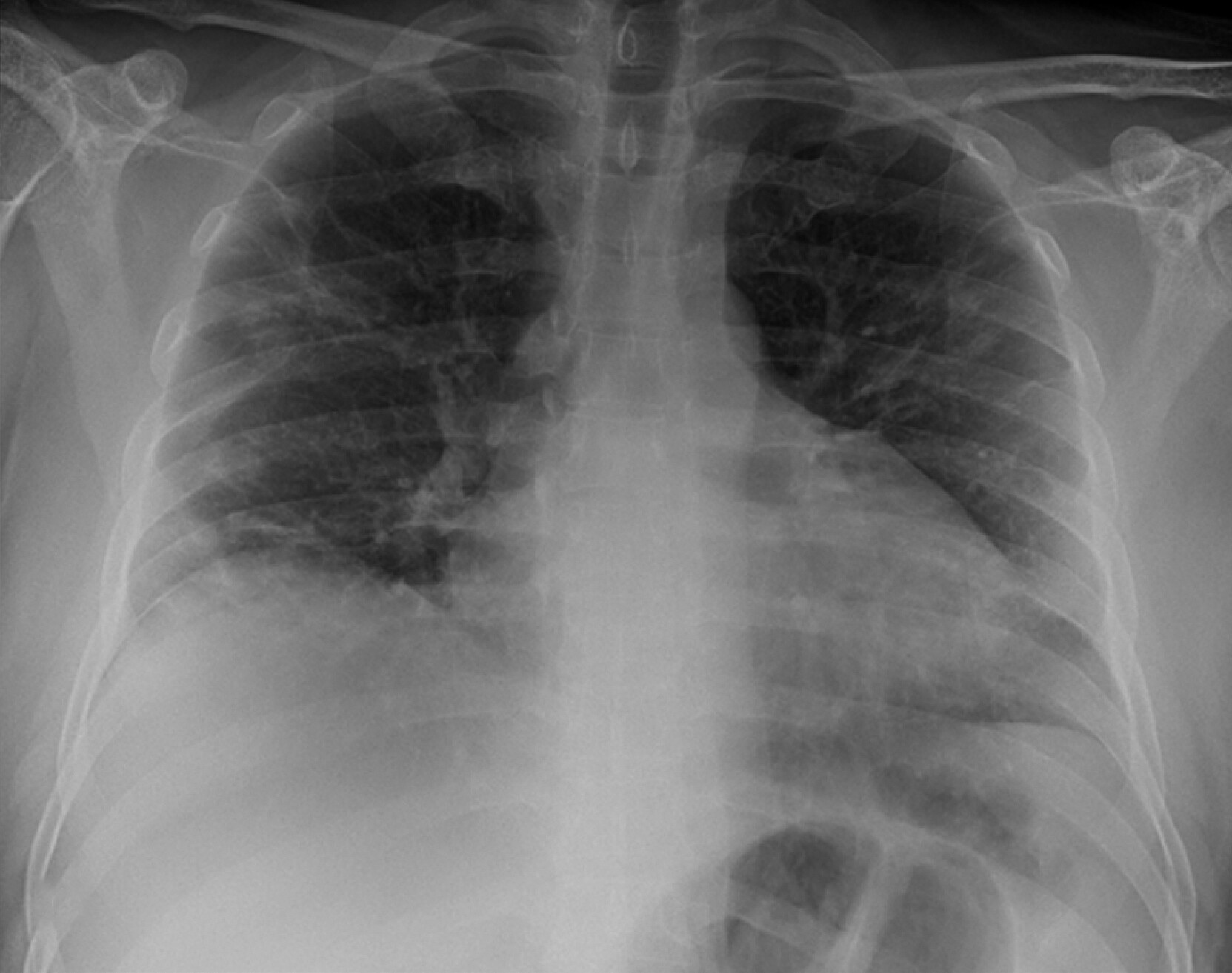
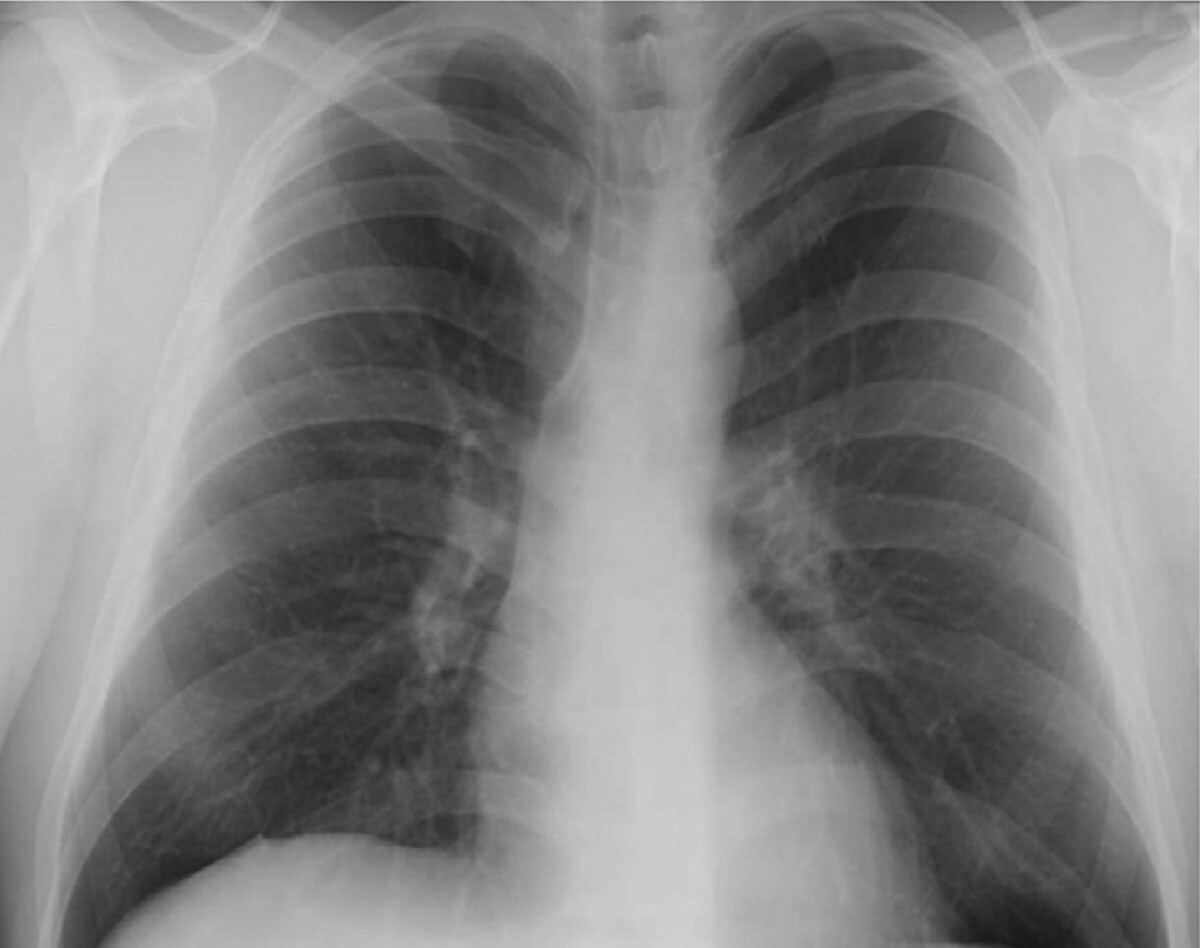
C T scans of lungs injured by C O V I D 19 and normal lungs. The Healthy lung shows clear and unmarred lung space, indicated by dark gray areas seen between the bones. The injured lung shows white clouds where the clear spaces should be indicating obstruction and damage of the airways.
Lung Injury by COVID-19More information
C T scans of lungs injured by C O V I D 19 and normal lungs. The Healthy lung shows clear and unmarred lung space, indicated by dark gray areas seen between the bones. The injured lung shows white clouds where the clear spaces should be indicating obstruction and damage of the airways.
Normal Lungs
TESTING At the clinic, Amber tested positive for COVID-19 caused by SARS-CoV-2, the coronavirus that emerged in 2019 and is now endemic (regularly occurring worldwide). Amber’s lung X-ray revealed fluid buildup and airway damage. Alarmed, Amber now requested the COVID vaccine—but the clinician explained that vaccination only prevents disease several weeks before infection. Amber received oxygen and stayed overnight at the hospital. Fortunately, her symptoms improved and she returned home.
DIAGNOSIS After a week at home, Amber’s initial symptoms were gone and she tested negative for virus. But she felt exhausted all the time.She had episodes of dizziness with a racing heartbeat, and she was diagnosed with a cardiac abnormality. She experienced “brain fog,” a condition in which she could not recall where she put things or the tasks needed for her job. Amber had to quit her job and go on government assistance. Two years after her initial COVID-19 infection, her lungs are scarred and have decreased capacity. Some of her symptoms improved, but her long-term conditions remain. Amber was diagnosed with long COVID, also known as post-COVID conditions (PCC).
SIGNS AND SYMPTOMS PCC can affect multiple organs, including the lungs, heart, and brain, and in some cases the liver and kidneys. Various combinations of post-COVID conditions may be experienced by 30% of those infected. While emerging therapies can alleviate post-COVID symptoms, there is no known cure. However, vaccination before infection can decrease the incidence (rate of occurrence) and severity of disease.
More information
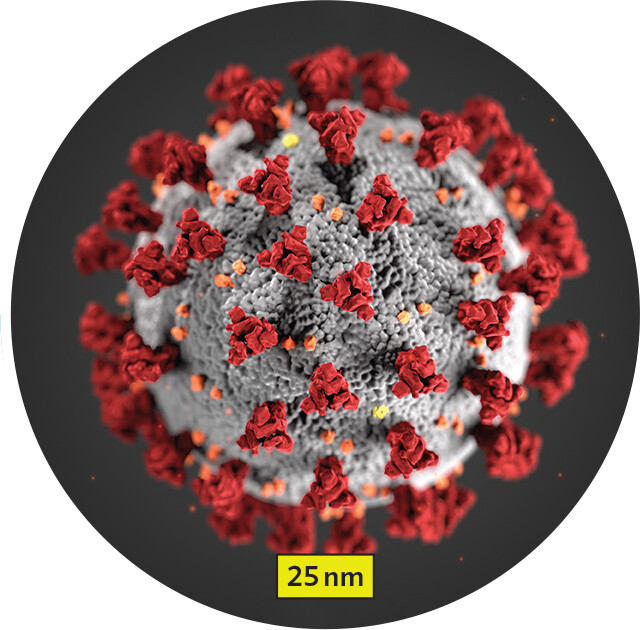
A model of the S A R S C o V 2 virus particle. The virus is spherical, with red, triangular protrusions dispersed evenly over its exterior surface. The particle has a diameter of about 1 nanometer. A caption reads, S A R S C o V 2, coronavirus, the cause of C O V I D 19.
SARS-CoV-2Coronavirus, the cause of COVID-19.
CHAPTER OBJECTIVES
After reading this chapter, you will be able to:
Describe the discovery of microbes related to human health, including the tools of microscopy and medical statistics.
Describe how environmental microbes are essential for human life.
Explain Koch’s postulates for showing that a microbe causes disease.
Explain how emerging pandemic diseases such as COVID-19 change human history.
Amber is one of millions of people affected by COVID-19 (or COVID), the disease that emerged in the historic pandemic of 2019–2023 and now occurs in seasonal outbreaks. During the pandemic, people with the disease filled hospitals, while the measures taken to slow the virus devastated global economies and society. The incidence of acute infections has now slowed, but post-COVID conditions are a growing part of health needs. Meanwhile, other microbial diseases of all kinds, from drug-resistant tuberculosis to sexually transmitted infections, challenge our health care providers.
Yet the microbes that cause disease are, surprisingly, outnumbered by other kinds of microbes that inhabit our bodies and our environment without causing us harm—and actually enable us to live. Our gut bacteria help our digestion and influence the function of our brains. In natural environments, all plants require nitrogen fixed by bacteria. Much of the oxygen we breathe is released by cyanobacteria and algae. And soil microbes such as streptomycetes produce most of the antibiotics we use to kill disease-causing pathogens.
In this chapter we introduce the concept of a microbe. We will then describe how humans discovered the roles of microbes in disease and in our environment. Finally, we will see how advances in microbial science, especially the discovery of the structure of DNA, have transformed medicine and society.
Note: SARS-CoV-2 virology is covered in Chapter 12, and COVID-19 respiratory infection is discussed in Chapter 20. Late-breaking discoveries important for health care are added online to the Norton Illumine Ebook.

 Note: SARS-CoV-2 virology is covered in