A photo of colored blocks displaying the letters, R S V, followed by an infographic about R S V. The infographic is titled, Unexpected Virus. It details a case of R S V in a young child. Text reads, Scenario: In the fall of 2022, Charmaine was a 2 year old child in New York who liked to build towers from the colored blocks that covered the floor of the family room. One day, when Charmaine came home from day care, her father noticed that she seemed tired and lacked interest in playing. Signs and Symptoms: Charmaine’s father took her temperature, which was about 39 degrees Celsius, or 102 degrees Fahrenheit, so he gave her a child’s tablet of acetaminophen. By that evening, she had a runny nose and refused to eat dinner. Her father then administered a home C O V I D 19 test, via nasal swab, but the result was negative. The following morning, Charmaine was coughing and wheezing. Her nostrils flared, she grunted to inhale, and the skin below her collarbone pulled in and out. Her father took her to the hospital. Testing and Diagnosis: Charmaine was administered quick P C R tests for various respiratory infections. She tested negative for C O V I D 19 and influenza, but positive for respiratory syncytial virus, abbreviated R S V. Her father was surprised, as he had not heard of this virus before. The clinician explained that R S V infects most children before age 2, and that most have mild or no symptoms. But during the pandemic shutdown of 2020 to 2022, fewer children were exposed to R S V and other respiratory infections. After the schools and day care centers reopened, R S V cases surged, and more cases with symptoms were seen. Treatment: Oxygen was administered to Charmaine through nasal prongs, and fluids were provided along with fever reducers. After 2 days, she was able to go home. Within a week, she had recovered and was building towers of blocks again. For further information, the father looked up R S V on the internet. The pattern of those tiny rod shaped virus particles reminded him of Charmaine’s blocks strewn on the floor. End text. There is a micrograph of R S V particles.
Unexpected Virus
More information
An illustrated silhouette of a child stacking blocks. The child is crouched down and attempting to carefully stack the blocks using one hand.
SCENARIO In the fall of 2022, Charmaine was a 2-year-old child in New York who liked to build towers from the colored blocks that covered the floor of the family room. One day, when Charmaine came home from day care, her father noticed that she seemed tired and lacked interest in playing.
SIGNS AND SYMPTOMS Charmaine’s father took her temperature, which was about 39ºC (102ºF), so he gave her a child’s tablet of acetaminophen. By that evening, she had a runny nose and refused to eat dinner. Her father then administered a home COVID-19 test (nasal swab), but the result was negative. The following morning, Charmaine was coughing and wheezing. Her nostrils flared, she grunted to inhale, and the skin below her collarbone pulled in and out. Her father took her to the hospital.
TESTING AND DIAGNOSIS Charmaine was administered quick PCR tests for various respiratory infections. She tested negative for COVID-19 and influenza, but positive for respiratory syncytial virus (RSV). Her father was surprised, as he had not heard of this virus before. The clinician explained that RSV infects most children before age 2, and that most have mild or no symptoms. But during the pandemic shutdown of 2020–2022, fewer children were exposed to RSV and other respiratory infections. After the schools and day-care centers reopened, RSV cases surged, and more cases with symptoms were seen.
More information
A photo of a child laying in a hospital bed, receiving oxygen administered via nasal prongs. The prongs rest in the nostrils. They are attached to clear tubing that loops over the ears before connecting to an oxygen delivery device beyond the view of the camera.
Oxygen Administered via Nasal Prongs
TREATMENT Oxygen was administered to Charmaine through nasal prongs, and fluids were provided along with fever reducers. After 2 days, she was able to go home. Within a week, she had recovered and was building towers of blocks again. For further information, the father looked up RSV on the Internet. The pattern of those tiny rod-shaped virus particles reminded him of Charmaine’s blocks strewn on the floor.
More information
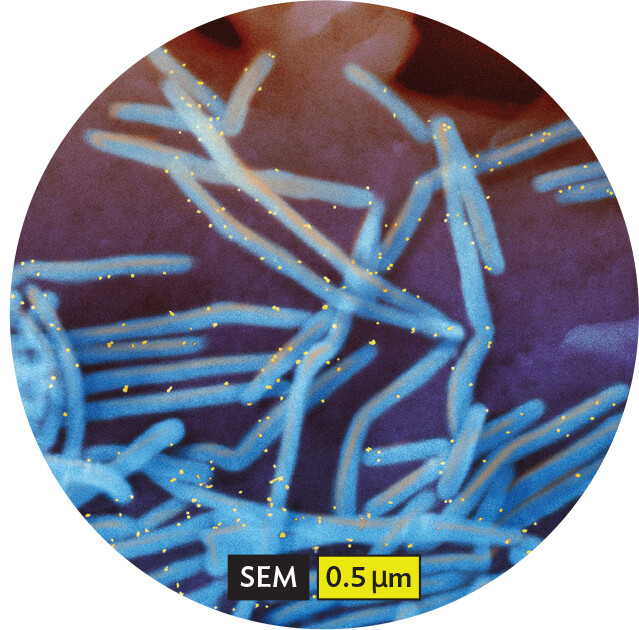
A scanning electron micrograph of respiratory syncytial virus, abbreviated R S V, particles. The particles are long, thin, and tubular in shape. Each particle is about 0.1 micrometer wide and 2 micrometers in length. They are seen in a disorganized clump. Tiny, spherical envelope proteins are visible on the outer surfaces of the particles.
Define the nature of a virus and explain how a virus differs from a cell.
Describe the major classes of viral genomes and cite an example of each.
Explain how viruses are cultured.
Describe the replication cycles of human papillomavirus (HPV), coronavirus SARS-CoV-2, influenza virus, and human immunodeficiency virus (HIV).
Explain how some viruses cause cancer.
Viruses, such as the respiratory syncytial virus (RSV) described in the chapter-opening case history, cause many common diseases in humans. RSV is spread readily by shared contact of surfaces such as furniture or toys (unlike coronaviruses, which are spread mainly by air inhalation). Yet other viruses introduced in this chapter are spread by the oral-fecal route or by sexual contact. Viral infections can have few or no symptoms, or they can cause rapid mortality, depending on the type of virus and the health of the host.
The influence of viruses on our history and culture is hard to overstate. More people died in the influenza pandemic of 1918 than in the battles of World War I. In the past 30 years, the AIDS pandemic caused by HIV has killed 25 million people worldwide. In 2019, a new coronavirus, SARS-CoV-2, caused the pandemic of COVID-19 (coronavirus disease of 2019), a respiratory illness that killed 7 million people worldwide by 2023 and caused the most severe economic disruption since the Great Depression of 1929.
Viruses have enormous impact on human lives and populations and on life throughout all ecosystems. For instance, in the open ocean, viruses are key predators at all levels of the food web, and they are the main source of predation that dissipates massive algal blooms. Every kind of cellular organism known, even the smallest of bacteria, can be infected by viruses.