A photo of a man dressed in business attire followed by a case study of a man with syphilis. In the photo, the man is covering his face behind his hands. He is wearing a white button up shirt with a blue tie. The case study that follows is titled, The Broker’s Secret. There is an illustrated silhouette of a man in a thoughtful pose at the center of the case study. There is also a photo of a syphilis chancre on a penis and a scanning electron micrograph of Treponema pallidum cells. The case study reads, Scenario: Brandon, a 30 year old stockbroker living in Chicago, visited his physician’s office. When the nurse asked Brandon why he was there, he blushed and said he wanted to talk only to the physician about his problem. Signs and Symptoms: One the doctor entered the room, Brandon explained that he had a small, round lesion on his penis. When asked about his sexual partners, Brandon initially said he was dating only one woman, but when pressed, he admitted having unprotected sex with two women and one man over the previous month. Upon examination, the lesion appeared to cause no pain but exuded a clear fluid. Testing: The physician quickly sent a sample of the fluid to the clinical laboratory. There, the sample was found to contain fast moving, corkscrew shaped bacteria. Diagnosis: The diagnosis was syphilis, caused by the bacterium Treponema pallidum. Left untreated, the disease could eventually cause horrible disfiguration and death. Treatment: Confident that he knew the cause, the physician gave Brandon a shot of long acting penicillin. The broker recovered and returned to the Chicago Stock Exchange. He was somewhat embarrassed, but considerably wiser.
The Broker’s Secret
More information
An illustrated silhouette of a man standing in a pensive pose. The man appears to be dressed in a button up shirt, long pants, and dress shoes. One arm is crossed over his chest and the other is bent to lift his hand up to his chin. His head is bent slightly forward, giving him the appearance that he is thinking.
SCENARIO Brandon, a 30-year-old stockbroker living in Chicago, visited his physician’s office. When the nurse asked Brandon why he was there, he blushed and said he wanted to talk only to the physician about his problem.
More information
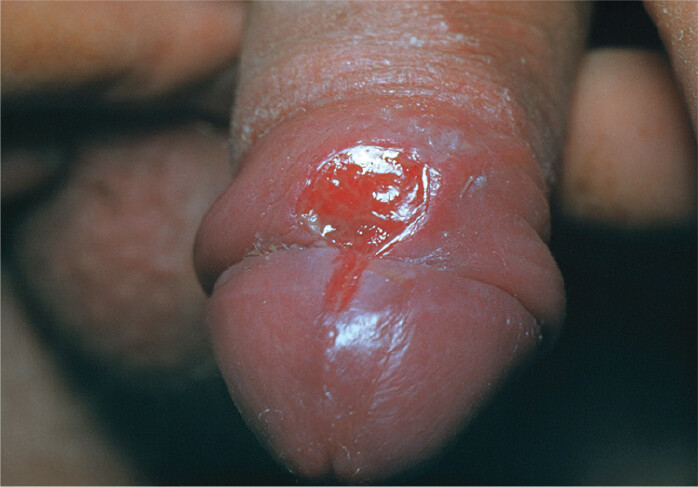
A photo of a syphilis chancre on the foreskin of a human penis. The ulcer has a well defined margin with a soft base. It is oozing a clear fluid. The surrounding skin of the penis does not appear affected. The caption reads, Chancre of syphilis. Note the single ulcer on the foreskin, usually painless and indurated, or hardened, with a well defined margin and a clear base.
Chancre of Syphilis Note the single ulcer on the foreskin, usually painless and indurated (hardened) with a welldefined margin and a clear base.
SIGNS AND SYMPTOMS Once the doctor entered the room, Brandon explained that he had a small, round lesion on his penis. When asked about his sexual partners, Brandon initially said he was dating only one woman, but when pressed, he admitted having unprotected sex with two women and one man over the previous month. Upon examination, the lesion appeared to cause no pain but exuded a clear fluid.
TESTING The physician quickly sent a sample of the fluid to the clinical laboratory. There, the sample was found to contain fast-moving, corkscrew-shaped bacteria.
DIAGNOSIS The diagnosis was syphilis, caused by the bacterium Treponema pallidum. Left untreated, the disease could eventually cause horrible disfiguration and death.
TREATMENTConfident that he knew the cause, the physician gave Brandon a shot of long-acting penicillin. The broker recovered and returned to the Chicago Stock Exchange; he was somewhat embarrassed, but considerably wiser.
More information
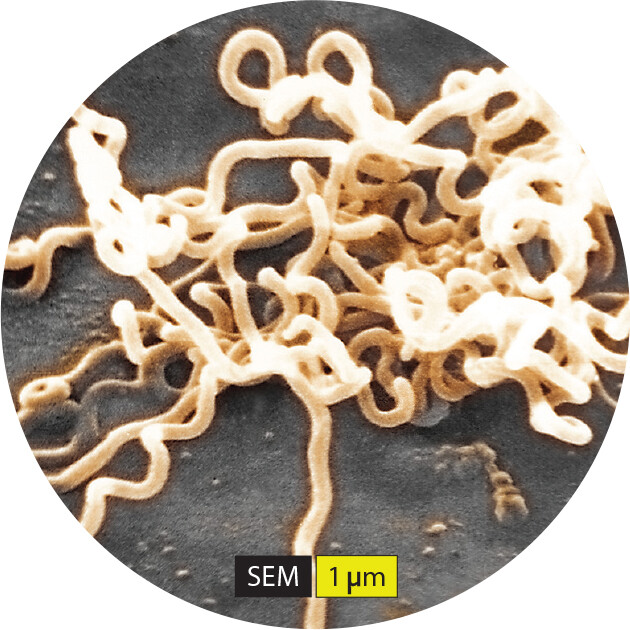
A scanning electron micrograph of Treponema pallidum. There are numerous spiral shaped bacteria. The bacteria are tangled together. Each cell spans several micrometers in length and about 0.25 micrometer in width. The caption reads, Treponema pallidum, A sexually transmitted, spiral shaped bacterium that can grow only in a host.
Treponema pallidum A sexually transmitted, spiral-shaped bacterium that can grow only in a host.
CHAPTER OBJECTIVES
After reading this chapter, you will be able to:
Describe the relationships between a host, its microbiome, and pathogens.
Apply basic concepts of pathogenesis to specific infections.
Discuss how infectious diseases impact communities and how communities shape emerging pathogens.
In 1493, a horrifying new disease emerged in Spain shortly after Columbus and his crew returned from the Americas. Victims developed disfiguring rashes, ulcers, violent fevers, and painful bone aches. Internal organs were irreparably damaged, and patients frequently died. After starting in Spain, the disease afflicted Italy, and by 1500 it had spread throughout Europe. Everyone believed it was a new disease (it was) and realized it was transmitted by sexual contact. This was almost 200 years before Antonie van Leeuwenhoek even discovered bacteria. Meanwhile, the French blamed the Italians, and the Italians said it must be the French; the English blamed both the French and Spanish or simply referred to it as “the pox.” By the 1520s, it was called syphilis, the same disease Brandon the stockbroker had in the opening case history of this chapter.
Medieval doctors were ignorant of the microbial world, but they still recognized that illnesses had signs and symptoms, and they deduced that some diseases mysteriously jumped between people. In a similar way, Brandon’s case illustrates how you, the student, can easily grasp the basics of an infectious disease even without knowing bacterial structure, genetics, or metabolism. Contrary to how microbiology is usually taught (cell function first, and then infectious disease), our introduction of infectious disease concepts in this second chapter will help you appreciate the elegance of bacterial form and function when we describe it later. Ultimately, you will see how a pathogen’s biology guides how it causes disease and reveals how we can treat it. By the way, today syphilis remains a growing epidemic, if not a pandemic. In 2021, there were 171,000 new cases of syphilis in the United States, up 68% from 2017.