CHAPTER 1
Foundational Ideas from Antiquity

The Greek Miracle and the Presocratic Philosophers
The Life and Thought of Socrates
An Atomic Footnote: Democritus, Epicurus, and Lucretius
Europe’s Intellectual Reawakening
While still in his late teens, the future philosopher Plato (ca. 424–347 B.C.) made a momentous decision about his education. Coming from a wealthy aristocratic family and being a prominent citizen of the democratic city-state of Athens, he had a wide choice of private teachers to guide his development. Most young men of his class chose to study with one of a group of highly regarded teachers called sophists. As strong supporters of Athenian democracy, a relatively new form of government that extended equal voting rights to all of its citizens, the sophists specialized in teaching the skills of rhetoric and public speaking that would enable their students to express and promote their political and social views most effectively. One famous sophist, a colorful figure named Gorgias, boasted that he could persuade people to adopt any opinion on any subject, even if he himself knew little or nothing about it. Years later Plato depicted Gorgias as asking: “What is there greater than the word which persuades the judges in the courts, or the senators in the council, or the citizens in the assembly, or at any other political meeting?”1
Rather than choosing someone who was highly successful in conventional terms like Gorgias, Plato opted for a teacher much more humble in his personal circumstances who offered his services at minimal cost and who taught from a very different point of view. Claiming that his only special wisdom was in knowing how much he did not know, Socrates (ca. 470–399 B.C.) wanted his students to appreciate what is true and permanent as opposed to temporarily convenient and popular. He did this by engaging his students in conversations or dialogues which encouraged them to discover their own innate capacities for finding truth, rather than passing on to them predetermined ideas or lessons. Both educational approaches had distinct virtues, and Plato’s choice resembled that facing a bright young person today whether to undertake training in a practical and potentially lucrative field like business or law, or to pursue a more impractical but idealized discipline like philosophy. His selection of Socrates and philosophy had consequences that still reverberate today.
Socrates himself left behind no written records of his thoughts. He opposed the entire notion of writing things down, believing that written ideas can represent true ones only partially and imperfectly, and that relying on writing weakens the faculties of memory and serious thinking. Fortunately for us, his pupil Plato rejected this particular belief, and years later provided many memorable written portrayals of his old teacher in what are now called the Socratic dialogues. These works—in which Plato added his own insights and interpretations to those of Socrates—emphasized the great importance of those “higher” capacities for rational thinking and mathematical reasoning that presumably reside innately within the human mind. The dialogues became foundational statements of the approaches to mental philosophy known as nativism, emphasizing inborn as opposed to acquired properties, and rationalism, emphasizing reason.
The wealthy and socially privileged Plato also promoted philosophical inquiry in another, more material way. In his 30s he inherited substantial property, where he established the Academy, a gathering place for scholars of varying ages and interests to congregate and pursue their intellectual goals. As a center for teaching and learning as well as what we today call scholarly research, the Academy has ever since lent its name to centers for higher learning. Although Plato’s own Socratically inspired approach was naturally emphasized, the topics pursued by scholars at the Academy also included mathematics and astronomy, and many diverse opinions were tolerated.
In 367 B.C., when Plato was in his late 50s, a 17-year-old from the northern Greek provinces named Aristotle (ca. 384–322 B.C.) arrived at the Academy. This son of an eminent but recently deceased physician quickly established himself as the institution’s top pupil, and then over a twenty-year period became its most distinguished senior scholar. Around the time of Plato’s death in 347, however, 37-year-old Aristotle decided to leave Athens and the Academy. One motive for his move may have been disappointment at being passed over as the Academy’s new leader, and another may have arisen from some intellectual differences between Plato and himself. Both explanations are plausible, since the non-aristocratic and non-Athenian Aristotle would probably have been passed over for the Academy’s leadership under any circumstances. Probably more importantly, Aristotle was predisposed—perhaps from seeing his father’s careful observations while diagnosing his patients—to place far more emphasis than his teacher did on the systematic observation of the natural, empirical world of the senses. Plato is said to have lamented that Aristotle “kicked us away, the way ponies do” when establishing their independence, and Aristotle, when writing about his break with Plato, declared that “we must honor truth above our friends.”2
Whatever his exact reasons, Aristotle abandoned the cloistered halls of academia and embarked on a twelve-year odyssey to the northern Greek provinces where he had been born. During this period he engaged extensively with the outside “real worlds” of natural history, politics, and pedagogy. These experiences amplified his already existing differences from Plato. Although he never denied the importance of certain innate rational faculties, Aristotle became the first great proponent of empiricism, the notion that true knowledge comes first and primarily through the processing of sensory experiences of the external world.
Commenting on the difference between Plato and Aristotle, one prominent historian of philosophy has exclaimed:
What an accident of history that two such contrasting orientations toward the physical world, animated by two such different aesthetic sensibilities, should have been pedagogically entangled with each other. [Plato] espies beauty in the elegance of the mathematical proportions he is certain rule the cosmos, [Aristotle] in the richness of sensed particularities he is certain can be functionally explained.3
This difference in viewpoints was captured by the Renaissance artist Raphael in his classic painting School of Athens, in which an older Plato points upward to the higher realms of reason and ideas, while the younger Aristotle gestures downward toward the empirical solidity of the earth (Figure 1.1). We shall see throughout this book that the interplay between what’s inside the mind and what acts upon it from the outside is a continuing and major theme in the history of psychology.
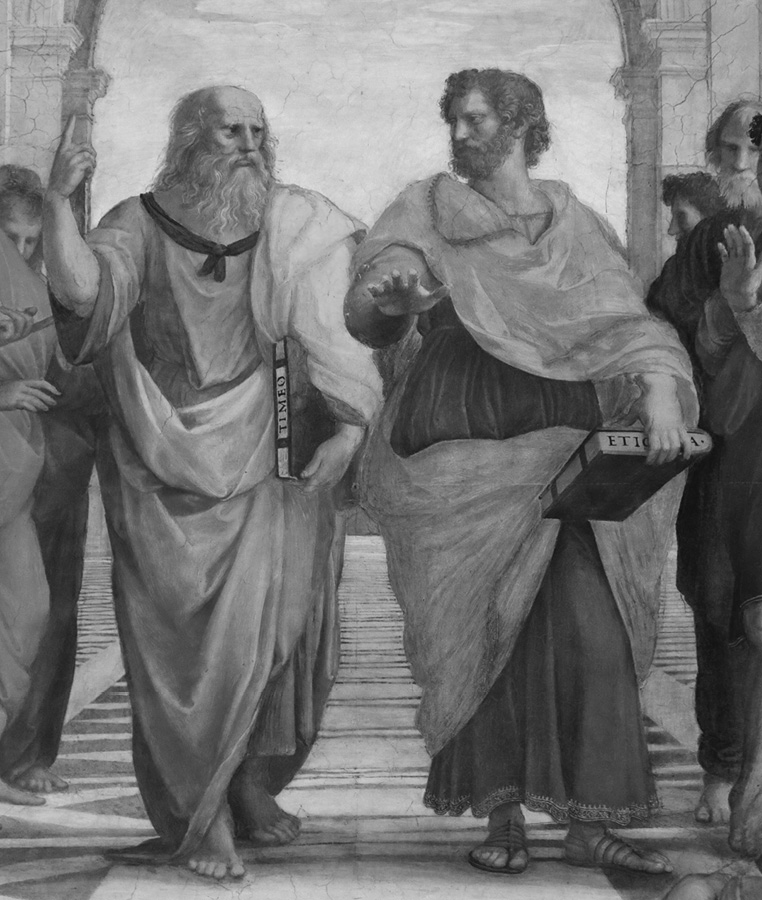
Figure 1.1 A detail from Raphael’s painting School of Athens, depicting Plato and Aristotle.
Figure 1.1 A detail from Raphael’s painting School of Athens, depicting Plato and Aristotle.
Considered together, the linked pedagogic chain of Socrates, Plato, and Aristotle established crucial philosophical foundations for an eventual discipline of psychology, and their individual stories will constitute the main elements of the first part of this chapter. We then relate how the atomic theory of matter was proposed by Democritus, a contemporary of Socrates, but gained little acceptance by Greek philosophers. The chapter concludes by describing how these and virtually all other classical ideas were dismissed by Western European scholars during the so-called Dark Ages, and would have been lost completely had they not been preserved and developed by numerous brilliant Islamic scholars between the years 700 and 1200. Only after that were they rediscovered and made essential components of the Western philosophical tradition.
As these accounts unfold it’s important to remember that no single pioneer arose in an intellectual vacuum. All of them were products of, and builders upon, their particular cultural and intellectual backgrounds. The principal Greek pioneers in this chapter were among the most luminous products of a remarkable time and place, sometimes referred to by historians as “the Greek miracle,” and they relied upon and further developed the earlier thought of a significant group of philosophers collectively known as the presocratics.