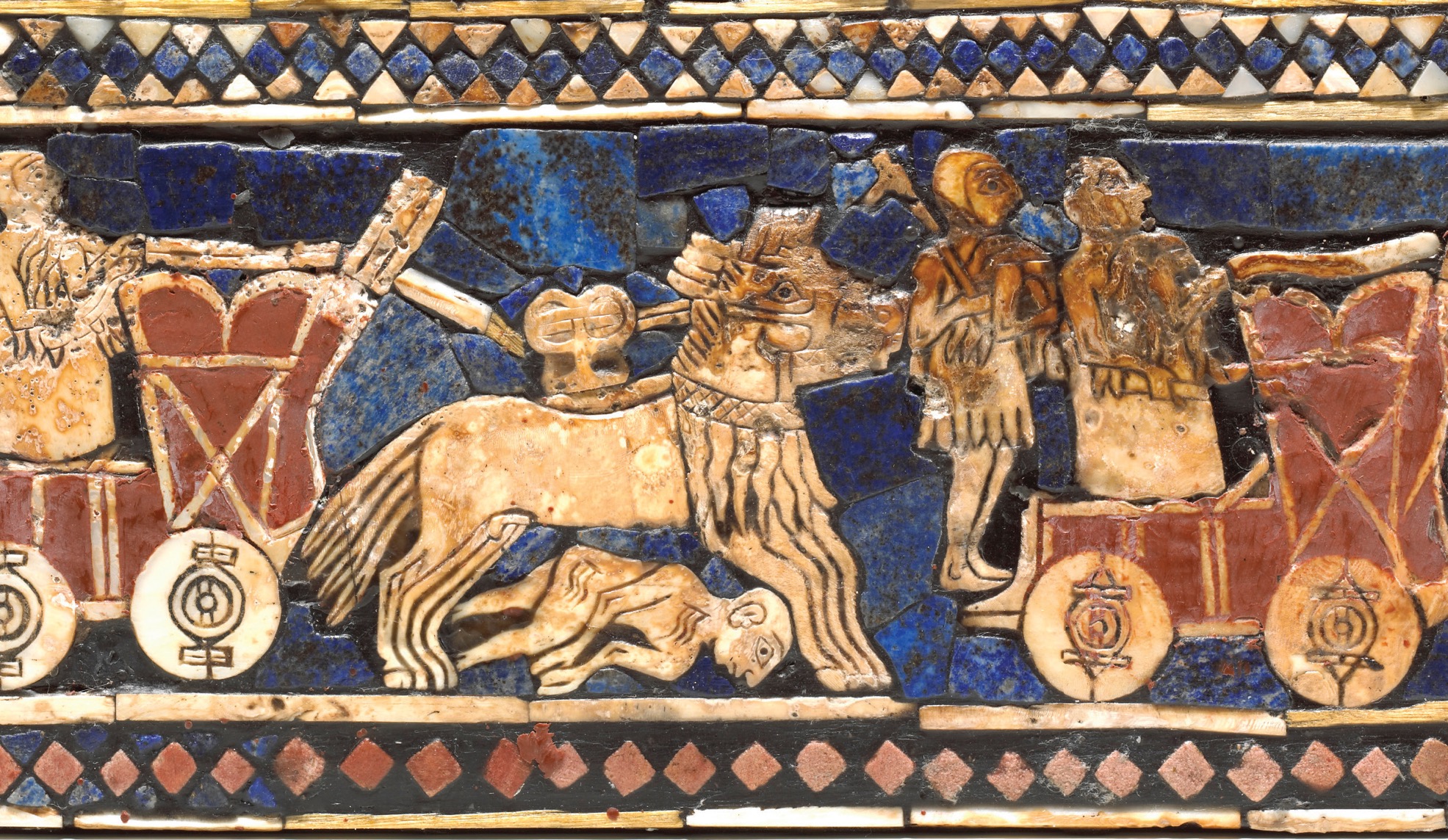
The Wheel Mosaics from the Sumerian city of Ur show soldiers riding into battle in wheeled, horse-drawn wagons. The wheel gave Sumerian troops an advantage over rival armies. These panels, inlaid with lapis lazuli and dated to around 2500 BCE, were found in a royal tomb.CHRONOLOGYOPENCLOSE
Between 8000 and 5000 BCELactose-tolerance genetic mutations occur in some people in West Africa, East Africa, northern Europe, Southwest Asia
ca. 7500 BCEÇatalhöyük settlement begins
ca. 7000 BCEPottery appears in the Fertile Crescent
By ca. 7000 BCEJericho is home to around 2,000 people
ca. 6000 BCEMesopotamians develop the potter’s wheel; largescale smelting operations begin
ca. 5000 BCEHerding becomes a full-time specialization
ca. 4800 BCEDomestication of horses
ca. 4500 BCEPottery appears in North America
ca. 4000 BCEEurasia’s Indo-European migrations begin
Between 3500 and ca. 1500 BCEComplex societies emerge in Mesopotamia, Egypt, Indus valley, China, Mesoamerica, Andes
By ca. 3500 BCESteppe people ride horses
ca. 3500 BCELarge-scale irrigation begins; Mesopotamian smiths begin making bronze; first wheels, axles, plows, and donkey caravans appear; pottery appears in South America
ca. 3300 BCELifetime of “Ötzi the Iceman”
ca. 3000–2500 BCEBantu-speakers migrate within West Central Africa
ca. 3000 BCEPeople begin to use sails efficiently
ca. 2000 BCEDomestication of camels
ca. 1500 BCELapita migrations begin
ca. 1500 BCE–500 BCEBantu-speakers migrate into East and southern Africa
ca. 500 BCEPolynesians reach Hawaii and Easter Island
ca. 1200 BCEPolynesians reach New Zealand
In 1991, hikers in the Ötz Valley near the mountainous border between Italy and Austria came upon a frozen corpse protruding from glacial ice. Medical examination revealed that “Ötzi the Iceman” was well preserved for his age: 5,300 years old. When he died, Ötzi was about 45 years old, elderly by the standards of his time. He stood 5′5″ (160 cm) tall and weighed about 110 lbs. (50 kg). He was brown-eyed, wore his hair long, and sported a shaggy beard and tattoos of small dots.
Few corpses have aroused as much scientific interest as Ötzi’s. The contents of his stomach showed that he had eaten two balanced meals within eight hours of his death: deer and mountain goat meat, roots, fruits, and wheat bran, perhaps eaten as bread. Pollen ingested with his last meals indicated that he died in the springtime. Clues in his fingernails suggested he had been sick three times in the six months before his death. Chemical analysis of his tooth enamel revealed he had grown up nearby, and slight deformations of his leg bones and pelvis indicated he did a lot of walking in hilly terrain. Genetic evidence showed he suffered from something similar to Lyme disease and was lactose intolerant (meaning he couldn’t digest milk or dairy products). His hands were smooth, suggesting he didn’t regularly handle rough objects and may have been a trader or a shaman.
Ötzi the Iceman was a sharp dresser, sporting an array of animal skins. His boots—bearskin soles with deerskin uppers—were so elegant that many researchers suppose he came from a society with specialist cobblers. He wore a striped goatskin vest, a calf-leather belt, goatskin leggings, and goatskin underwear. He topped it all off with a bear-fur cap.
Ötzi carried an axe with a precision-crafted blade of almost pure copper, an expensive material. Like his elaborate dress, this suggested that Ötzi may have been prosperous. He also had with him a sewing kit, a fire-starter kit with fungi and flints, a modest medical kit including some natural antibiotics, a small dagger held in a sheath, a deerskin quiver with 14 arrows, and an unfinished bow.
Ötzi needed his weapons. He had bruises and cuts on his legs, hands, and chest, implying hand-to-hand combat. DNA analysis of blood found on his body and clothes indicates that others, whether friends or enemies, were wounded with him. The fight apparently took place shortly before his death. Someone shot an arrow into his back that sliced through his shoulder blade, severed an artery, and lodged under his armpit. Enfeebled by the wound and several bruises on his skull, he froze to death.
His murder remains a very cold case. Who killed Ötzi? Why was he walking near a mountain pass and carrying so much gear? How did he get into a fight, and why was he shot in the back? Was he a trader heading over the mountains? Was he a traveling shaman? Was he fleeing from someone? Despite the remarkable ingenuity of the many scientists who have pried into Ötzi’s secrets, even locating some of his living relatives in Austria, we have no answers.
The first half of this chapter will focus on the world that Ötzi knew, one that developed after farming had begun to spread and before there were any cities—in other words, the millennia known as the Neolithic. In Southwest Asia, this world lasted from roughly 10,000 to 3500 BCE. But in sub-Saharan Africa and Polynesia, for example, it started later and comes forward much closer to the present, in some particulars to about 1000 CE. The second half of the chapter considers the emergence and character of cities, states, and complex society—defined when we get there—with special attention to some common features among early complex societies, including social hierarchy, writing, and metallurgy. The chapter concludes with observations on the enduring challenges to complex societies and the intriguing parallels among them.