18Cultural UpheavalsRELIGIOUS AND INTELLECTUAL MOVEMENTS1500 to 1750
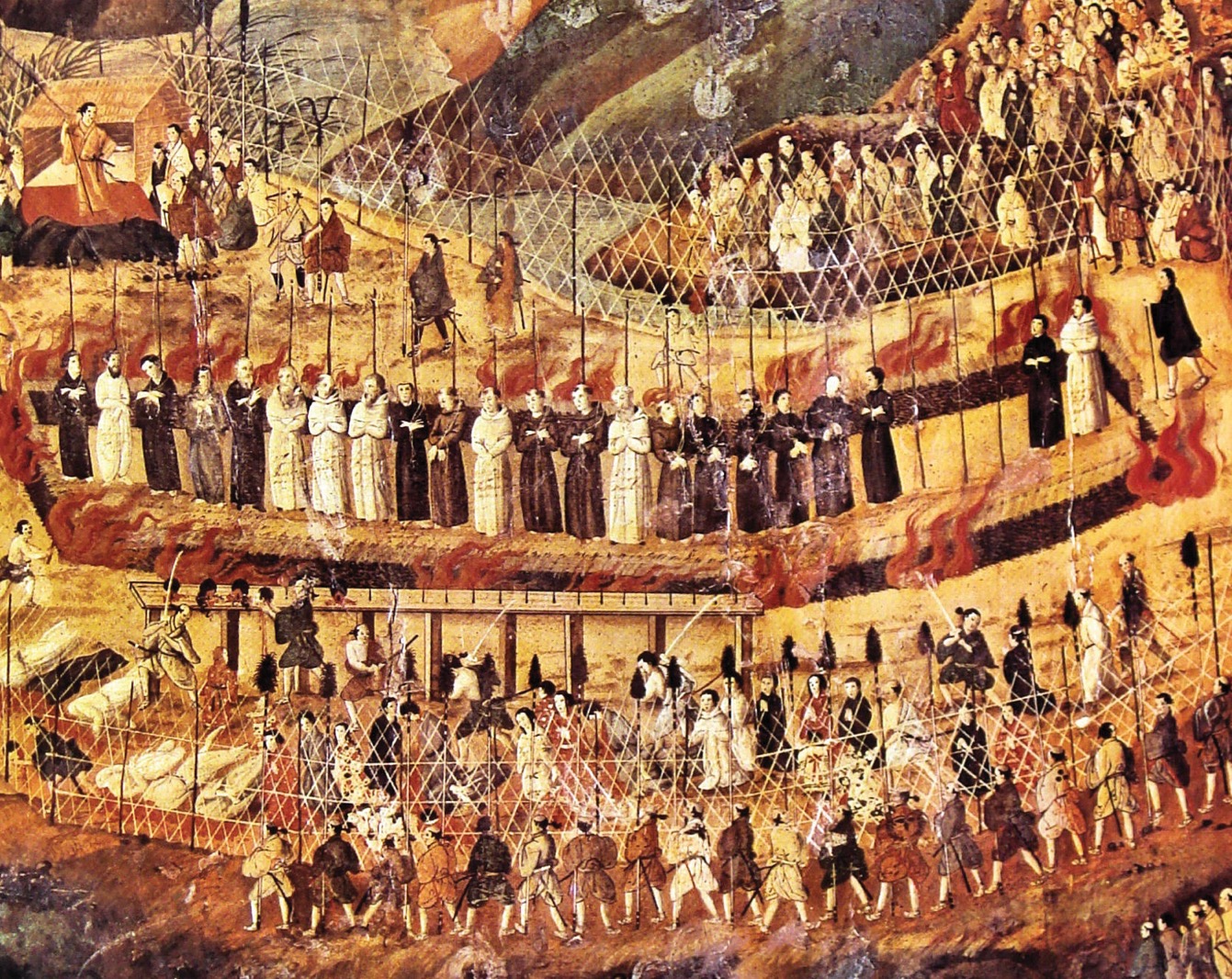
Religious Conflict Dozens of Christians are beheaded and burned at the stake during a backlash against European Christian missionaries in sixteenth-century Japan. The period saw religious upheaval around the world, as new sectarian movements and stronger global connections caused different traditions to come into contact—and conflict—for the first time.CHRONOLOGYOPENCLOSE
1430–1450Johannes Gutenberg develops moveable type and printing press
ca. 1450Safavis embrace Shi’a Islam
1469–1539Lifetime of Nanak
1472–1529Lifetime of Wang Yangming
1501Ismail establishes a Safavid state in Iran
1514Nicolas Copernicus writes down his heliocentric system
1517Martin Luther writes Ninety-Five Theses
1540Founding of the order of Jesuits
1542Re-establishment of the Inquisition
1555Treaty of Amasya; Peace of Augsburg
ca. 1580Reaction against Wang Yingming’s followers
1587–1629Reign of Shah Abbas I
1597Christianity is banned in Japan
1603First academy of science is founded in Rome
1606Sikhs abandon pacifism and begin military tradition
1608Invention of the telescope
1618–1648Thirty Years War
ca. 1620Peak of European witch hunts
1687Newton publishes his Mathematical Principles of Natural Philosophy
1702First daily newspaper
1724Christianity is banned in China
About 1545, a Japanese samurai named Anjirō killed someone in a brawl. His remorse led to the introduction of Christianity into Japan. Although sorry for his deed, Anjirō chose to flee and live as an outlaw. In 1547 he met a Portuguese sea captain in the port of Kagoshima on Japan’s southern island of Kyushu—Portuguese sailors had recently started looking for trade opportunities in Japan. The sea captain suggested that Anjirō might feel better about his crime if he consulted a priest, specifically a Spanish Jesuit named Francis Xavier. The Jesuits were a newly founded (1540) order of priests within the Catholic Church dedicated to evangelizing non-Catholics and to rigorous education.
Francis Xavier worked as a missionary throughout the Portuguese Empire in Asia. Anjirō met him in 1547 at Malacca, the cosmopolitan city on the Malayan Peninsula where shipping passed between the Indian Ocean and the South China Sea. While Xavier explained to him the merits of Catholicism, Anjirō—in broken Portuguese—convinced Xavier that the people of Japan might be willing to try a new religion. Together they went to Goa, the Portuguese enclave in India, where Anjirō studied Catholic theology and the Portuguese language at a Jesuit college. In 1548 he was baptized a Christian. Then they returned to Malacca, boarded a Chinese pirate ship (the only one they could find heading to Japan), and arrived at Kagoshima in 1549, intending to convert Japan to Catholicism.
Japan was fragmented politically and religiously at the time. Buddhism was the primary spiritual path, and several different Buddhist sects competed for followers. They also competed with ritual-rich Shinto, Japan’s oldest religion. Xavier and Anjirō drew crowds in Kagoshima. Anjirō translated the Christian concept of God as Dainichi, one of the Japanese terms for the Buddha. That and the fact that they had come from India, the home of the Buddha, added to the interest Japanese took in their preaching. The Japanese at first understood Catholicism as another version of Buddhism coming straight from the Buddha’s homeland.
Xavier and Anjirō met with a warm reception from the local authorities until, two years into their mission work, Xavier concluded that Anjirō’s translation did not convey the true nature of God. He started using the Latin word Deus instead and began to denounce Dainichi as a creature of the devil. His reception in Kagoshima cooled quickly.
Xavier left Kagoshima for the capital city of Kyoto, where he hoped to convert the emperor. But he never received an imperial audience, and in 1552 was recalled by the Jesuits to Goa. He died en route. Anjirō, meanwhile, lost most of his following in Kagoshima and returned to a life of crime, taking up piracy. He died at sea.
Nonetheless, his followers won many converts, and by 1579 some 130,000 Japanese came to call themselves Christians. The oceanic voyaging of the Portuguese, together with Anjirō’s remorse and Xavier’s ambition, brought new ideas to Japan, shaking up its spiritual and political order.
Forging the Global web was a disruptive and destructive process, but also a creative one. As we saw in Chapter 17, joining the web wrought havoc on peoples in Africa, the Americas, Siberia, and Oceania, but in time generated new, hybrid societies and cultures. Within the Old World web, the process was disruptive and creative too, not least in the realm of ideas. During the centuries from 1500 to 1750, the convergence of the webs helped to drive major challenges to established patterns of thought, leading to new religions, schisms in old religions, new paths within old philosophies—and to the beginnings of modern science. These are the subjects of this chapter.
Founded in 1540 in Spain, an order of priests in the Catholic Church dedicated to evangelizing non-Catholics and to rigorous education. During the sixteenth and seventeenth centuries, Jesuit missionaries worked to counter Protestantism in places as varied as Poland, Germany, Japan, China, India, and the Americas.